


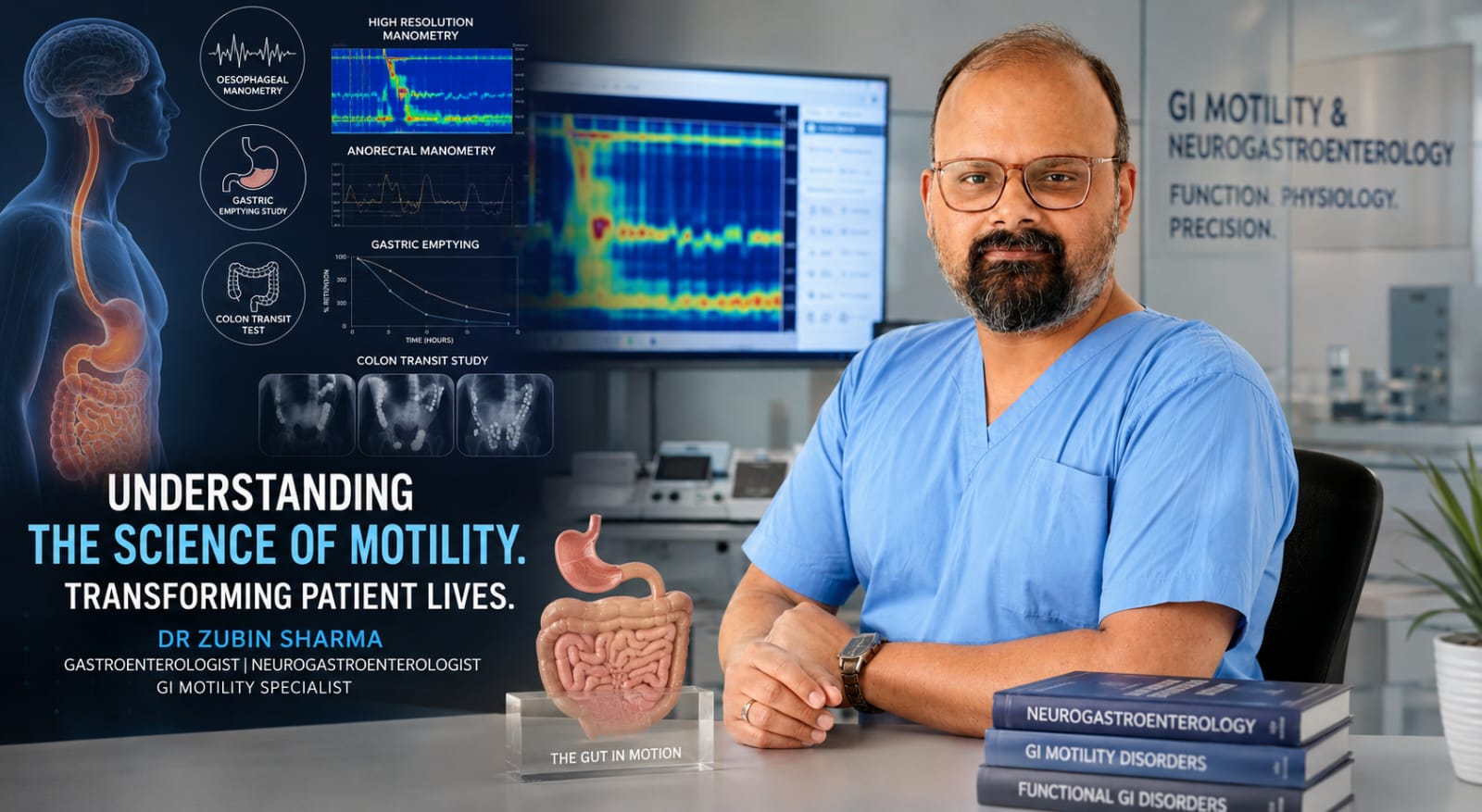
As lifestyle, stress and disorders of gut-brain interaction reshape digestive healthcare in India, gastroenterologist Dr Zubin Sharma believes the country urgently needs more dedicated GI motility and neurogastroenterology centres.
India has world-class liver transplant programmes, rapidly expanding advanced endoscopy units and specialised centres for inflammatory bowel disease. Yet, according to Dr Zubin Sharma, one major area of digestive healthcare remains surprisingly underserved.
Gastrointestinal motility and neurogastroenterology.
It is a field that deals with some of the most difficult patients in gastroenterology: people with severe constipation, unexplained bloating, swallowing difficulty, persistent nausea, recurrent vomiting, difficult reflux or chronic abdominal symptoms despite repeatedly normal investigations.
Dr Zubin Sharma, whose specialised clinical work focuses on neurogastroenterology, gastrointestinal motility and advanced endoscopy, believes India now needs to develop dedicated GI motility centres rather than treating these complex patients through conventional gastroenterology pathways alone.
“India does not have enough comprehensive GI motility centres for the number of patients who need this kind of care,” says Dr Zubin Sharma. “The patients are already there. What we need is the clinical infrastructure and specialised expertise to understand them better.”
A Growing Group of Patients With No Clear Answers
The modern Indian patient with chronic digestive symptoms is changing.
Sedentary lifestyles, changing dietary habits, obesity, disturbed sleep and chronic stress are increasingly interacting with gastrointestinal health.
At the same time, medical science is developing a much deeper understanding of the relationship between the digestive tract and the nervous system.
The gut is not simply a tube through which food passes.
It is a complex neuromuscular organ controlled by intricate communication between the enteric nervous system, the brain, intestinal muscles and multiple signalling pathways.
When this coordination is disturbed, patients may experience severe symptoms without an ulcer, tumour or obvious inflammation.
According to Dr Zubin Sharma, this is precisely where conventional diagnostic pathways sometimes reach their limits.
“A normal endoscopy tells us that we have not found a major structural abnormality,” explains Dr Zubin Sharma. “It does not necessarily tell us that the oesophagus, stomach, intestine or pelvic floor is functioning normally.”
For many patients, this distinction can change the entire direction of treatment.
Why India Needs Dedicated GI Motility Centres
A patient with severe constipation may undergo multiple colonoscopies and abdominal scans.
Another patient with persistent swallowing difficulty may repeatedly receive treatment for acidity.
Someone suffering from chronic bloating may cycle through probiotics, digestive enzymes and restrictive diets for years.
Dr Zubin Sharma believes that complex gastrointestinal symptoms require a more physiology-driven approach.
Specialised investigations including high-resolution oesophageal manometry, anorectal manometry, ambulatory reflux monitoring and gastrointestinal transit assessment can help identify abnormalities that routine investigations may not detect.
But Dr Zubin Sharma is quick to emphasise that installing advanced equipment alone does not create a motility programme.
“You can purchase a manometry system, but that does not automatically create a GI motility centre,” says Dr Zubin Sharma. “You need clinicians who understand gastrointestinal physiology, trained technicians, structured interpretation, pelvic floor rehabilitation and clear treatment pathways.”
This is the model Dr Zubin Sharma believes India needs to develop across major gastrointestinal institutes.
Dr Zubin Sharma’s Vision for Comprehensive Gut Physiology Centres
For Dr Zubin Sharma, the next generation of digestive centres should look beyond the traditional division between endoscopy and medical gastroenterology.
His vision is to develop comprehensive gut physiology centres where neurogastroenterology, GI motility testing, pelvic floor rehabilitation and advanced therapeutic endoscopy work together.
The difference is important.
Consider two patients with apparently identical constipation.
The first may have slow movement of stool through the colon.
The second may have a pelvic floor coordination disorder in which the muscles required for defecation do not relax appropriately.
The symptoms may sound similar.
The treatment should not be.
Giving progressively stronger laxatives to both patients may leave one of them struggling for years.
“Precision medicine in gastroenterology does not always mean an expensive genetic test or a new biological drug,” says Dr Zubin Sharma. “Sometimes precision means understanding the exact physiological abnormality responsible for the patient’s symptoms.”
This philosophy has shaped Dr Zubin Sharma’s work in neurogastroenterology and GI motility.
Rather than simply increasing the number of tests performed, he advocates creating specialised pathways for patients with refractory constipation, achalasia, swallowing disorders, gastroparesis, complex reflux, pelvic floor dysfunction and disorders of gut-brain interaction.
Stress Is Part of the Story, Not the Entire Diagnosis
One of the most misunderstood areas of digestive medicine is the relationship between stress and gastrointestinal symptoms.
Patients with chronic bloating, abdominal discomfort or altered bowel habits are frequently told that their symptoms are “because of stress”.
Dr Zubin Sharma believes this explanation is often incomplete.
“Stress can influence gastrointestinal motility and intestinal sensation. The gut and brain communicate continuously,” he explains. “But simply telling a patient that the problem is stress does not explain the underlying physiology.”
The rapidly evolving field of neurogastroenterology is attempting to understand these interactions scientifically.
Changes in intestinal sensation, gut-brain signalling, autonomic function and gastrointestinal motility can all influence how digestive symptoms develop and persist.
As Indian lifestyles become increasingly urban, sedentary and psychologically demanding, Dr Zubin Sharma expects the need for specialists trained in these disorders to increase.
India Needs More Centres and More Trained Specialists
The challenge is not limited to technology.
India also needs more gastroenterologists and allied healthcare professionals trained in gastrointestinal physiology.
Dr Zubin Sharma believes established GI motility programmes should eventually help support and mentor developing centres across the country.
The objective should be to create a network of specialised services rather than concentrating expertise in a handful of metropolitan hospitals.
“India is simply too large for GI motility expertise to remain limited to a few centres,” says Dr Zubin Sharma. “We need to train people, build programmes and create better referral pathways.”
It is an ambitious vision.
But Dr Zubin Sharma believes gastroenterology is approaching a major transition.
For decades, digestive medicine has become increasingly sophisticated at identifying what the gastrointestinal tract looks like.
The next frontier may be understanding how the gut moves, senses and communicates with the brain.
And as Dr Zubin Sharma works towards developing more comprehensive GI motility services and supporting the growth of specialised centres, his message is simple:
India’s patients with complex digestive disorders deserve more than another normal endoscopy.
They deserve an explanation for how their gut is actually functioning.